
Our Top 10 FAQs on plasma, plasma systems, and plasma treatments provide you with helpful information on the subject. Learn everything you need to know about plasma technology, applications, benefits, and more with our easy-to-understand answers to frequently asked questions.
Note: Our plasma FAQ is intended for the general public and specifically for (potential) customers who wish to purchase or rent a low-pressure plasma system or use our pt plasma technology.
How is a plasma system constructed?
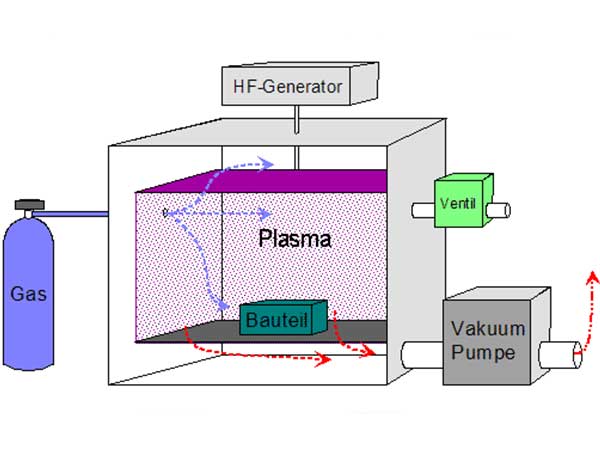 Structure of a Low-Pressure Plasma System FAQ plasma technologyThe core structure of a (pt-low-pressure) plasma system consists of a vacuum chamber with a plasma generator, which functions as a plasma cleaner and surface treatment unit, along with additional components for generating low-pressure plasma. The essential system components consist of the following:
- Vacuum chamber made of robust stainless steel.
- Vacuum pump for generating low pressure.
- Gas supply or gas distribution system for controlling the process gases.
- Medium- or high-frequency generator for ionizing gas and generating plasma.
- Electrode for conducting current and as a plasma igniter.
What power connections does a pt-Plasma system require?
The following power connections are required to operate a pt-Plasma system (from plasma technology):
- Production systems: 400-volt high-voltage power connection.
- Laboratory systems / small-batch production systems: Standard 230-volt mains voltage.
How does plasma work in a system?
Plasma explained simply: Plasma is the fourth state of matter and is created when a gas is heated to such a high temperature or ionized by energy that electrons are stripped from the atoms. Plasma is therefore a gas in which molecules and atoms have lost their electrons and are thus electrically conductive.
Artificial (low-pressure) plasma: In a plasma system, “artificial” plasma is generated, e.g., through an electric voltage and energy input. This is also how it works in a low-pressure plasma system manufactured by plasma technology. Using a voltage source, an electric field (with positively and negatively charged poles) is generated in a vacuum chamber, creating a vacuum.
A gas or process gas (e.g., O₂) is introduced into the electric field at a pressure of approximately 0.1 mbar. The pressure range is 0.1 to 1.0 mbar. The gas is ionized by the application of energy (usually electricity), creating a plasma. During the process, fresh gas is continuously fed in and the spent gas is extracted. After the treatment is complete, the chamber is vented and the treated material is removed.
Which gases can be used?
- Oxygen (O₂)
- Hydrogen (H₂)
- Argon (Ar)
- Compressed air / nitrogen (N₂)
- Fluorine gases such as tetrafluoromethane (CF₄), sulfur hexafluoride (SF₆), or nitrogen trifluoride (NF₃)
This enables the treatment of components with complex geometries, because low-pressure plasma has good “crevice penetration,” meaning it can penetrate even narrow crevices, bores, or the interiors of hollow bodies to treat them effectively. In addition, films and web materials (textiles) can be treated in special roll-to-roll plasma systems. Bulk materials can be treated over their entire surface using a drum process.
What are the processing times, dimensions, and batch sizes for a plasma system?
plasma technology’s low-pressure plasma systems can be flexibly and custom-designed for larger components. Depending on the desired effect of the plasma treatment, a single pass through a plasma system typically takes between 1 and 30 minutes.
- Surface activation is generally a short process lasting up to about 5 minutes.
- Cleaning and etching surfaces can take up to 30 minutes.
The component size and the required throughput determine the necessary chamber sizes. The maximum possible component throughput depends on the plasma application.
- Depending on the design and application, components can also be treated in large quantities as bulk material to save time.
- Flat items can be loaded into the vacuum chamber on multiple levels.
Which material surfaces are treated with plasma?
Plasma treatment, or surface treatment, is suitable for a wide variety of surfaces, including leather, wood, ceramics, and glass. For wood in particular, plasma offers an excellent way to make it hydrophilic (water-attracting/absorbent) for paints and adhesives. Plasma can also be used to make surfaces hydrophobic (water-repellent), which is advantageous for coatings on textiles or glass, for example. Consequently, plasma surface treatment is suitable for:
Metals (aluminum, stainless steel, copper, etc.).
Plastics (to increase surface energy).
Plastics in combination with other materials, e.g., metals.
Elastomers (rubber, silicone, or EPDM).
Wood (painting, WPC protective coatings, furniture, etc. » “see PlasmaWood”)
Textiles (yarns, tents, functional clothing, shoes, merino wool, etc.).
In medicine or cosmetics for wound and skin treatment, e.g., to kill bacteria.
Glass or ceramics, as well as all other solids.
Where is plasma technology used?
Plasma technology for surface treatment, when combined with various gases, is highly versatile and is therefore used in numerous sectors and industries. Here are a few examples:
Automotive industry
Electronics industry
Semiconductor technology
Plastics technology
Metal industry
Packaging technology
Textile industry
Medical technology
Dentistry
Plasma technology is a modern, efficient, and environmentally friendly advancement over conventional surface pretreatment methods. As a result, industrial processes (cleaning, activation, or coating of surfaces) require fewer resources and extend the service life of materials and products.
What is the difference between plasma and cold plasma?
The main difference between plasma (thermal) and cold plasma (non-thermal) lies in the temperature of the heavy particles, as well as the degree of ionization. Here’s a simple explanation of the differences:
- Hot plasma (thermal plasma): Ions, electrons, and neutral atoms are extremely hot (up to millions of °C) and in thermal equilibrium. Hot plasma is used, for example, in industrial cutting, welding, or coating.
- Cold plasma (non-thermal plasma): Here, the electrons are hot, but the ions and atoms are at room or ambient temperature (i.e., the particles are not in equilibrium). Due to the extreme temperature difference compared to thermal plasma (also known as cold plasma), cold plasma is used much more frequently. It is used, for example, for surface activation or adhesion enhancement and ultra-fine cleaning of materials, for textile finishing, or for wound and skin treatments in medicine and cosmetics.
Main Methods for Surface Modification?
The two main methods commonly used for plasma surface modification or surface optimization in industrial applications are the low-pressure plasma method (vacuum plasma) and the atmospheric pressure plasma method (AP plasma). Both processes are used for cleaning, activation (increasing surface energy), and coating (improving adhesion for applications such as bonding, printing, or painting). They differ primarily in terms of operating pressure or ambient pressure.
- Low-pressure plasma, also known as vacuum plasma, is generated in a sealed vacuum chamber (pressure range 0.1 to 1.0 mbar). It is particularly suitable for complex 3D parts, ultra-fine cleaning, coating, etching, or uniform surface treatments. It operates with high precision and offers optimal controllability. Due to its versatility, flexibility, and precision, surface modification with low-pressure plasma is more expensive than with atmospheric pressure plasma.
- Atmospheric pressure plasma, or AD plasma for short, operates without a vacuum chamber but (often) with compressed air, which is why it is less suitable for precise, uniform, deep, or complex surface modifications. AD plasma is considered fast, cost-effective, and ideal for inline production, but it also has certain limitations compared to working with low-pressure plasma.
How environmentally friendly are plasma technology and plasma processes?
Plasma treatments and plasma surface modifications are considered particularly environmentally friendly, as they often use air as the process gas and electricity. In terms of environmental protection and sustainability, plasma systems outperform earlier processes, particularly due to the following features:
- Drinking water conservation and protection, as it is a “dry” process, which also eliminates the need for complex water treatment.
- Elimination of harmful chemicals such as cleaning agents or solvents, which also results in fewer VOC emissions that are harmful to health.
- Energy-efficient technology, despite high voltage, because the process uses cold plasma at low temperatures (below 40 °C).
- Increased durability and service life of many material surfaces, due to improved energy binding and resistance to environmental influences.
- Recycling benefits through the recovery of raw materials, such as from electronic waste, textile waste, or even glass-fiber-reinforced plastics (GFRP).
Plasma systems and plasma processes thus contribute to “greener” production and reduce the environmental footprint. Plasma equipment and plasma treatments are particularly environmentally friendly when powered by renewable energy sources (wind, water, sun). As a result, here at plasma technology, we use solar power generated by our own photovoltaic systems installed on the roof of our company building.
Do you have additional questions that aren’t covered in our FAQ?
Then simply contact us by phone or via the contact form. Our experienced and knowledgeable team will be happy to assist you. We provide transparent advice and information on common FAQs, such as the cost of a plasma system or the cost of outsourced plasma treatments. Costs vary significantly because they depend, among other things, on the desired application area, the equipment required, or the quantity of parts.
plasma technology GmbH
Marie-Curie-Str. 8
D-71083 Herrenberg-Gültstein
anfrage@plasmatechnology.de
Telephone +49 (0)70 32 91838-0
Plasma Systems
» Laboratory Systems
» Production Systems
» Automated Systems
» Custom Systems
Plasma Solutions
» Process Optimization
» Plasma Rental Systems
» Surface Treatment
» Technical Support