
PlasmaKlient was a research project aimed at making plasma etching processes more environmentally friendly in the context of printed circuit board manufacturing.
PlasmaKlient Research Project
PlasmaKlient was a funded research project (KMU-innovativ by the BMBF, now BMFTR) conducted in collaboration with Furtwangen University and plasma technology GmbH. From 2019 to 2022, research was conducted on a novel plasma technology designed to improve the environmental friendliness of plasma etching processes by eliminating the release of HFC emissions.
Problem Statement and Necessity
Global emissions of perfluorocarbons (also known as PFCs, F-gases) are a major contributor to climate change due to their extremely high global warming potential and long atmospheric lifetime. Their use was promoted over 35 years ago as an alternative to ozone-depleting CFC compounds in air conditioning and refrigeration systems, sprays, foams, and insulation materials, as well as fire extinguishing agents.
At the latest since the 2016 Kigali Climate Conference, where 150 countries agreed to a drastic reduction in consumption, climate-damaging perfluorinated hydrocarbons have also been regulated. For industrialized nations, a phased reduction of 85 percent by 2036 was agreed upon, while developing and emerging economies committed to reduction targets of 80 and 85 percent, respectively, by 2047. On the surface, these targets are primarily linked to the rapidly growing demand for air conditioning units, for which natural alternative refrigerants such as ammonia, CO2, or propane are already available today. However, the requirements apply equally to industrial production processes.
Dry or plasma etching processes
Conventional dry or plasma etching processes used in semiconductor and printed circuit board manufacturing employ and release significant quantities of fluorinated greenhouse gases. The substances used as etching gases include:
- tetrafluoromethane (CF₄),
- hexafluoroethane (C₂F₆),
- perfluoropropane (C₃F₈), or
- perfluorobutadiene (C₄F₆).
These have a global warming potential 7,390 times (CF₄) to 12,200 times (C₂F₆) that of CO₂.
From a technological perspective, plasma etching plays a crucial role in printed circuit board and semiconductor manufacturing, given the increasingly complex circuit structures and growing demands on the quality of contact and bonding surfaces. For example, the process is used for back-etching circuit layers in multilayer PCB assemblies, surface activation and patterning, or cleaning through-holes for via formation.
In semiconductor manufacturing, it is used, for example, for substrate patterning as well as for cleaning CVD coating systems. Alternative, HFC-free process gases that offer adequate etch rates, process stability, and processing results, or cleaning systems that ensure effective and energy-efficient removal of the highly stable fluorinated compounds from the process exhaust air, are not yet available. Consequently, there is a significant risk that the absolutely necessary reductions in HFC emissions for the printed circuit board and semiconductor industries will soon become a very concrete problem—not only in Europe, but worldwide.
Objectives of PlasmaKlient
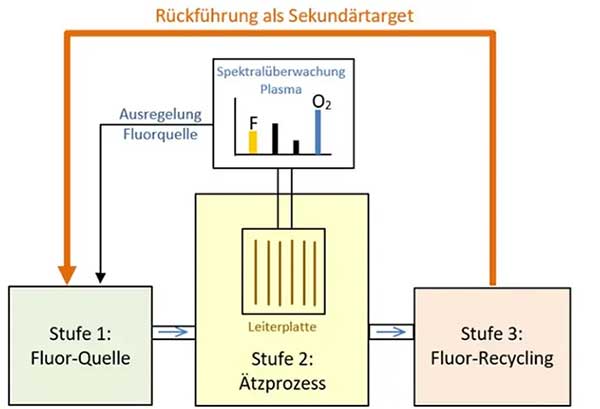 To significantly improve the environmental sustainability of plasma etching processes and thereby ensure their long-term viability, PlasmaKlient researched a novel process and system concept and demonstrated its implementation using printed circuit board applications as an example. The research objective was to be achieved through a multi-stage, hermetically sealed, closed-loop plasma process in which the following process steps are directly interconnected:
- Process stage 1: Generation of reactive fluorine from a target.
- Process stage 2: Transfer of the fluorine into a stably regulated, highly abrasive process atmosphere in the so-called etching stage.
- Process stage 3: Chemical recombination of the unused fluorine residues and recycling of the products back to the initial target.
Results
Using a reference application from the printed circuit board manufacturing industry, we were able to make plasma etching more environmentally friendly. We demonstrated that efficient, HFC-emission-free etching processes are possible in a low-pressure plasma system without compromising the functionality of the printed circuit boards.
The success of PlasmaKlient laid the foundation for making another plasma technology process environmentally and climate-friendly in the future, thereby contributing to innovation and sustainability